Bringing Climate Science Down to Earth
Building Bridges Between NASA Scientists and Classroom Teachers
Bringing Climate Science Down to Earth
Building Bridges Between NASA Scientists and Classroom Teachers
Bringing Climate Science Down
to Earth
Building Bridges Between NASA Scientists and Classroom Teachers
Overview
Three organizations united to transform climate science teaching in American classrooms: NASA’s Goddard Institute for Space Studies (GISS), Real World Matters, and Mindblue Education. NASA’s Goddard Institute for Space Studies (GISS), is a world leader in climate research based at Columbia University. Real World Matters is an education company dedicated to expanding quality career-connected learning with real-world problem-solving and Mindblue Education is a leader in curriculum design and innovative professional development.
Together, we created something unprecedented: a direct bridge between working climate scientists and classroom teachers that would transform how climate science moves from research labs to students. This partnership gave teachers an important seat at the table with valued roles and a critical voice in evaluating and customizing educational materials. The resulting model proved both scalable and sustainable, leading to lasting relationships between scientists and educators that extended far beyond initial training sessions.
Highlights
- 56 teachers served across 5 states (IL, MI, NM, NY, VA) in the 2013 & 2014 Climate Change in the Classroom Events
- 18 NASA & Columbia scientists participated
- Four adaptable units were developed in collaboration with NASA scientists
- Featured in six media / academic publications including a 2015 feature in the New York Times Learning Network
- One district-wide climate literacy program developed (featured in EdWeek)
Overview
Three organizations united to transform climate science teaching in American classrooms: NASA’s Goddard Institute for Space Studies (GISS), Real World Matters, and Mindblue Education. NASA’s Goddard Institute for Space Studies (GISS), is a world leader in climate research based at Columbia University. Real World Matters is an education company dedicated to expanding quality career-connected learning with real-world problem-solving and Mindblue Education is a leader in curriculum design and innovative professional development.
Together, we created something unprecedented: a direct bridge between working climate scientists and classroom teachers that would transform how climate science moves from research labs to students. This partnership gave teachers an important seat at the table with valued roles and a critical voice in evaluating and customizing educational materials. The resulting model proved both scalable and sustainable, leading to lasting relationships between scientists and educators that extended far beyond initial training sessions.
Highlights
- 56 teachers served across 5 states (IL, MI, NM, NY, VA) in the 2013 & 2014 Climate Change in the Classroom Events
- 18 NASA & Columbia scientists participated
- Four adaptable units were developed in collaboration with NASA scientists
- Featured in six media / academic publications including a 2015 feature in the New York Times Learning Network
- One district-wide climate literacy program developed (featured in EdWeek)
How we used Mindblue Education’s 3P Framework
Purpose
Build powerful professional learning communities that elevate isolated teaching into a collaborative practice that puts student growth at the center
Play
Design structured yet flexible celebratory workshops (a ‘festival of learning’) where teachers showcase classroom practices, receive peer feedback, and build lasting collaborative relationships across grade levels
Paradox
Making teacher collaboration meaningful and actionable while respecting the time constraints and daily demands of classroom teaching
The Challenge
As climate change became increasingly urgent in the 2010s, K-12 educators faced a perfect storm. Teachers felt overwhelmed by rapidly evolving science, isolated from scientific practice and struggled to keep up with continuously shifting educational standards. Without access to current research, interdisciplinary resources, or professional development, many avoided the topic altogether – precisely when students needed it most. Traditional professional development kept teachers lecture-bound rather than engaged with real science.
Key Insights
- Direct Scientist-Teacher Collaboration: Connecting educators directly with NASA scientists in collaborative workshops elevated both parties’ expertise during curriculum development.
- Peer-to-Peer Learning Model: The environment with scientists differed dramatically from business-as-usual professional development, creating authentic collaboration rather than top-down instruction.
- Knowledge & Confidence Building: Teachers built essential content knowledge and confidence while contributing their educational expertise to the climate conversation.
- Customizable Resources: Providing base digital curriculum and video lectures that teachers could remix to fit their classroom needs proved highly valuable, balancing structure with creativity.
- Informal Learning Environment: The conversational, casual setting proved crucial for authentic professional learning and relationship-building between scientists and educators.
The Challenge
As climate change became increasingly urgent in the 2010s, K-12 educators faced a perfect storm. Teachers felt overwhelmed by rapidly evolving science, isolated from scientific practice and struggled to keep up with continuously shifting educational standards. Without access to current research, interdisciplinary resources, or professional development, many avoided the topic altogether – precisely when students needed it most. Traditional professional development kept teachers lecture-bound rather than engaged with real science.
Key Insights
- Direct Scientist-Teacher Collaboration: Connecting educators directly with NASA scientists in collaborative workshops elevated both parties’ expertise during curriculum development.
- Peer-to-Peer Learning Model: The environment with scientists differed dramatically from business-as-usual professional development, creating authentic collaboration rather than top-down instruction.
- Knowledge & Confidence Building: Teachers built essential content knowledge and confidence while contributing their educational expertise to the climate conversation.
- Customizable Resources: Providing base digital curriculum and video lectures that teachers could remix to fit their classroom needs proved highly valuable, balancing structure with creativity.
- Informal Learning Environment: The conversational, casual setting proved crucial for authentic professional learning and relationship-building between scientists and educators.
Pivotal Moment
As teachers and scientists began casual conversations over lunch, the typical professional development dynamic transformed. Scientists shared their latest research while teachers offered classroom perspectives. Questioning was a two-way street leading to organic exchanges that became the model for all future workshops, creating lasting relationships that extended far beyond the initial training.
The Solution & Implementation Model
To bring climate change education to 6-12 grade American classrooms, the team developed a hybrid model. Intensive in-person workshops where teachers co-developed curriculum with science were supported with ongoing virtual support. Intensive in-person workshops where teachers co-developed curriculum with scientists in a peer-to-peer environment were supported with ongoing virtual resources. A digital curriculum provided structure while encouraging adaptation. Targeted virtual check-ins and an online community maintained momentum between face-to-face sessions and connected classrooms to a leading climate science workplace.
Pivotal Moment
As teachers and scientists began casual conversations over lunch, the typical professional development dynamic transformed. Scientists shared their latest research while teachers offered classroom perspectives. Questioning was a two-way street leading to organic exchanges that became the model for all future workshops, creating lasting relationships that extended far beyond the initial training.
Pivotal Moment
As teachers and scientists began casual conversations over lunch, the typical professional development dynamic transformed. Scientists shared their latest research while teachers offered classroom perspectives. Questioning was a two-way street leading to organic exchanges that became the model for all future workshops, creating lasting relationships that extended far beyond the initial training.
The Solution & Implementation Model
To bring climate change education to 6-12 grade American classrooms, the team developed a hybrid model. Intensive in-person workshops where teachers co-developed curriculum with science were supported with ongoing virtual support. Intensive in-person workshops where teachers co-developed curriculum with scientists in a peer-to-peer environment were supported with ongoing virtual resources. A digital curriculum provided structure while encouraging adaptation. Targeted virtual check-ins and an online community maintained momentum between face-to-face sessions and connected classrooms to a leading climate science workplace.
The Solution &
Implementation Model
To bring climate change education to 6-12 grade American classrooms, the team developed a hybrid model. Intensive in-person workshops where teachers co-developed curriculum with science were supported with ongoing virtual support. Intensive in-person workshops where teachers co-developed curriculum with scientists in a peer-to-peer environment were supported with ongoing virtual resources. A digital curriculum provided structure while encouraging adaptation. Targeted virtual check-ins and an online community maintained momentum between face-to-face sessions and connected classrooms to a leading climate science workplace.
Implementations & outcomes
Discover: partner identification, needs analysis, program design
- Recruited advisory board of educators and scientists to drive development
- Explored most relevant and engaging content for secondary classrooms
- Built full project team with complementary expertise
Design: advisory team workshops, curriculum evaluation, development, resource creation
- Created digital resource library and ongoing support network
- Tested and iterated on curricular materials with teacher advisory board
- Revised content based on feedback and prepared for larger forums
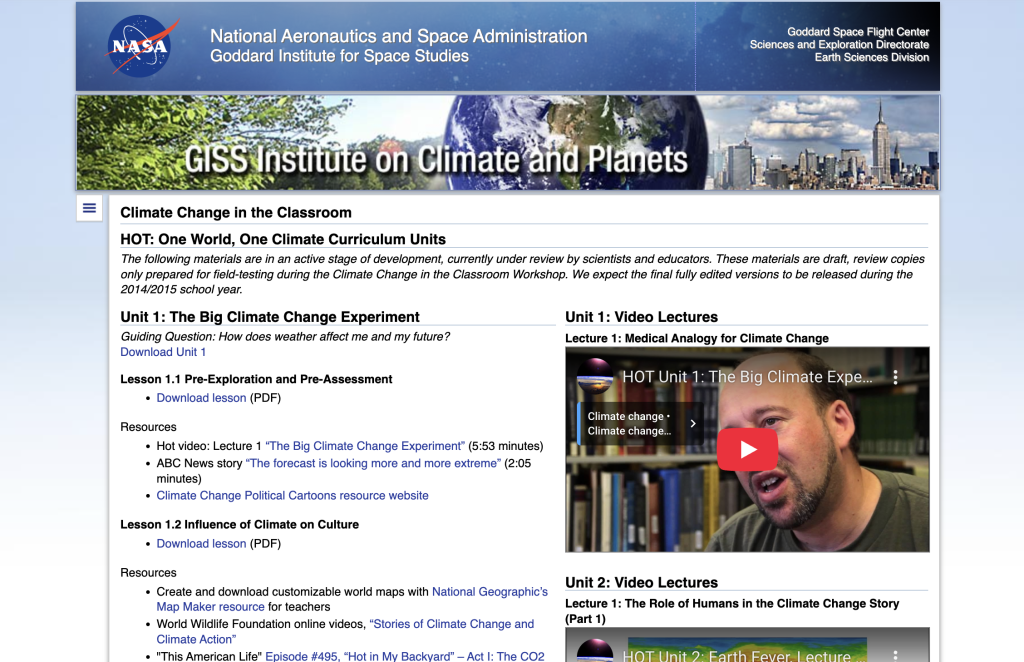
- Released “Hot: One World, One Climate” curriculum on NASA’s educational platform
Demonstrate: early implementation, teacher iteration and development
- Hosted multiple online and in-person workshops with scientists and teachers
- Supported educators to align curriculum to state and national standards
- Conducted series of 5 in-person and online teacher-scientist collaborative workshops
- Cultivated teacher-scientist relationships extending beyond initial workshops
Develop & Disseminate: classroom implementation tracking program expansion, model refinement, online support, data analysis, public communication
- Published research and outreach in peer-reviewed journals including Social Studies and the Young Learner
- Garnered recognition in The New York Times Learning Network and Education Week
- Inspired district-wide climate literacy professional learning program
- Tracked implementation impact across participating schools and districts
Implementations & outcomes
Discover: partner identification, needs analysis, program design
- Recruited advisory board of educators and scientists to drive development
- Explored most relevant and engaging content for secondary classrooms
- Built full project team with complementary expertise
Design: advisory team workshops, curriculum evaluation, development, resource creation
- Created digital resource library and ongoing support network
- Tested and iterated on curricular materials with teacher advisory board
- Revised content based on feedback and prepared for larger forums
- Released “Hot: One World, One Climate” curriculum on NASA’s educational platform
Demonstrate: early implementation, teacher iteration and development
- Hosted multiple online and in-person workshops with scientists and teachers
- Supported educators to align curriculum to state and national standards
- Conducted series of 5 in-person and online teacher-scientist collaborative workshops
- Cultivated teacher-scientist relationships extending beyond initial workshops
Develop & Disseminate: classroom implementation tracking program expansion, model refinement, online support, data analysis, public communication
- Published research and outreach in peer-reviewed journals including Social Studies and the Young Learner
- Garnered recognition in The New York Times Learning Network and Education Week
- Inspired district-wide climate literacy professional learning program
- Tracked implementation impact across participating schools and districts
Implementations & outcomes
Discover: partner identification, needs analysis, program design
- Recruited advisory board of educators and scientists to drive development
- Explored most relevant and engaging content for secondary classrooms
- Built full project team with complementary expertise
Design: advisory team workshops, curriculum evaluation, development, resource creation
- Created digital resource library and ongoing support network
- Tested and iterated on curricular materials with teacher advisory board
- Revised content based on feedback and prepared for larger forums
- Released “Hot: One World, One Climate” curriculum on NASA’s educational platform
Demonstrate: early implementation, teacher iteration and development
- Hosted multiple online and in-person workshops with scientists and teachers
- Supported educators to align curriculum to state and national standards
- Conducted series of 5 in-person and online teacher-scientist collaborative workshops
- Cultivated teacher-scientist relationships extending beyond initial workshops
Develop & Disseminate: classroom implementation tracking program expansion, model refinement, online support, data analysis, public communication
- Published research and outreach in peer-reviewed journals including Social Studies and the Young Learner
- Garnered recognition in The New York Times Learning Network and Education Week
- Inspired district-wide climate literacy professional learning program
- Tracked implementation impact across participating schools and districts
Featured Media
- Teachers and Scientists Meet at NASA GISS for Climate Change Workshop, NASA News Feature
- The Climate is A-Changin’: Teaching Civic Competence for a Sustainable Climate, Social Studies and the Young Learner (National Council of Social Studies Educators)
- A Year of PD: One District’s Strategy for Training Teachers on Climate Change, EdWeek
- Climate Change Questions for Young Citizen Scientists, The New York Times Learning Network
- Hot: One World, One Climate Curricula, NASA GISS Institute on Climate and Planets

Contact
This NASA partnership demonstrates how bringing experts, institutions, and educators together can transform teaching and learning in any subject area. Contact Mindblue Education to explore how we can help your organization bridge the gap between specialized knowledge and effective classroom practice.
Contact
This NASA partnership demonstrates how bringing experts, institutions, and educators together can transform teaching and learning in any subject area. Contact Mindblue Education to explore how we can help your organization bridge the gap between specialized knowledge and effective classroom practice.